Unicorn Letter Tracing Book for Toddlers: A Creative Bridge Between Magic and Motor Skill Development
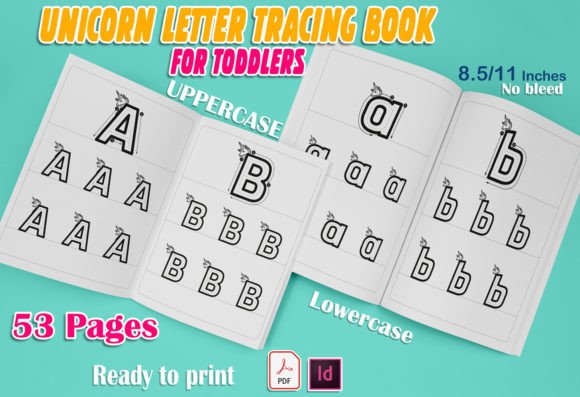
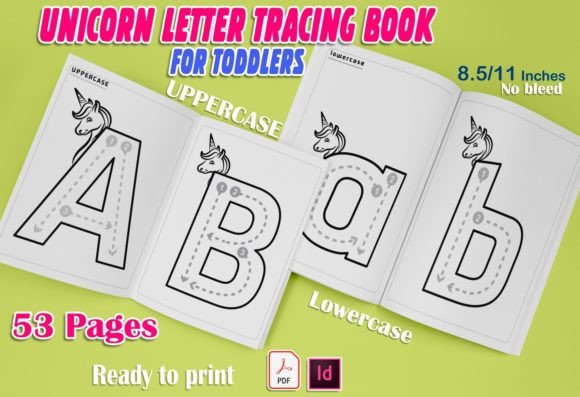
Early childhood literacy tools have shifted dramatically in the last decade, yet one truth remains constant: children learn best when play and imagination lead the way. The Unicorn Letter Tracing Book for Toddlers capitalizes on this intersection, blending the enchantment of unicorns with the foundational exercise of letter formation. It is not simply a collection of worksheets; it is a thoughtfully assembled 53-page interior created for print-on-demand publishing, homeschooling, and classroom use. Inside, you will find 52 dedicated letter tracing pages—26 practice sheets for uppercase A-Z and 26 for lowercase a-z—all designed to help small hands build handwriting motor skills with consistency and joy. The artwork steers clear of distraction and focuses on large, clear letter guides, giving toddlers both structure and a sense of achievement.
This resource arrives as a ready-to-use KDP interior bundle containing a high-resolution PDF and an Adobe InDesign (INDD) file. The trim size is set to the universal 8.5×11 inches, with no bleed, making it instantly compatible with major print-on-demand platforms and home printers alike. For parents, educators, and creative entrepreneurs, the download delivers a genuine shortcut: you open a ZIP file, extract the files, and you are ready to print or publish. That readiness is more than a convenience; it reflects a broader market expectation for immediate, polished, customizable content that respects both a toddler’s learning needs and an adult’s limited time.
Why the Unicorn Theme Matters for Letter Learning
Walk into any children’s bookstore, browse a preschool supply aisle, or scroll through a parent community on social media, and you will see unicorns everywhere. This is not a fleeting fad. Unicorns represent a safe, vibrant world that children naturally want to enter. When a toddler opens a Unicorn Letter Tracing Book for Toddlers, the whimsical imagery lowers resistance to what might otherwise feel like a chore. The sparkling appeal can turn “Let’s practice writing” into “Let’s visit the unicorn letters,” a subtle emotional shift that increases session length and reduces pushback.
Beyond surface appeal, a well-designed unicorn theme can serve as a gentle cognitive anchor. Associating the shape of a letter with a friendly visual cue—such as a unicorn nudging the letter “U” or a rainbow beside “R”—helps toddlers build memory connections. The brain ties narrative context to motor patterns, which is particularly valuable for kinesthetic learners who thrive on multi-sensory input. Experts in early childhood development have long emphasized the power of themed learning to sustain focus, and this product harnesses that principle without overcomplicating each page. The unicorn accents remain decorative, not disruptive, so the letter form remains the hero.
Letter Tracing Pages for Toddlers: A Shift Toward Intentional Screen-Free Practice
Digital learning apps are everywhere, yet many parents and occupational therapists are reinvigorating their commitment to tactile, screen-free practice. Tablet games can reinforce letter recognition, but they rarely replace the fine motor demands of gripping a pencil, crayon, or marker. The Letter Tracing Pages for Toddlers included in this bundle target exactly that gap. Each worksheet isolates one letter per page, presenting it in a generous outlined format that allows young children to trace within forgiving boundaries. Over time, this repetitive motion builds muscle memory, grip strength, and the hand-eye coordination necessary for future independent writing.
The current educational climate shows a renewed interest in evidence-backed handwriting instruction. States and school districts that had abandoned cursive or delayed manuscript instruction are beginning to reintroduce explicit handwriting practice, recognizing its role in reading fluency and neural development. For toddlers, the journey starts well before kindergarten. Providing a structured yet low-pressure tool at home or in a preschool setting aligns with research that connects early fine motor competence to later academic confidence. These tracing pages do not rush the child. They offer a calm, repetitive format that lets progress happen organically, one unicorn-adorned letter at a time.
What Makes a Great KDP Interior for Letter Tracing Books
For self-publishers and content creators, the phrase “KDP Interiors” carries weight. Amazon’s Kindle Direct Publishing ecosystem rewards interiors that are printer-friendly, carefully formatted, and aligned with customer expectations. The Unicorn Letter Tracing Book for Toddlers arrives with specifications that minimize friction: a clean 8.5×11 inch trim size that mirrors most activity books, a no-bleed layout that avoids trimming errors, and a high-resolution 300 DPI setting that ensures crisp printing. Both PDF and INDD formats are provided, giving the publisher immediate access as well as full editability through Adobe InDesign for those who want to tweak font placements, adjust page order, or inject branding elements.
Many low-content book creators find that a common frustration is interiors that look inconsistent across print runs. This product addresses that by including only essential design elements and avoiding borders or decorative elements that might shift during the printing process. Because each letter tracing page maintains generous margins and balanced spacing, the final printed book feels professional rather than template-driven. The 53-page count—which includes a title page along with the 52 worksheets—is substantial enough to convey value without becoming unwieldy or expensive to produce. For authors who want to create a unicorn-themed series, the INDD file becomes a springboard for adding bonus pages, progression charts, or a completion certificate.
Practical Implications for Parents, Educators, and Creators
Imagine a stay-at-home parent seeking to prepare a three-year-old for preschool. They download the ZIP file, extract the PDF, and print the first few lowercase pages on standard letter paper. Within minutes, the child is tracing “a” while spotting a tiny unicorn hoof print in the corner. The parent notices that the child’s grip improves over a week of five-minute daily sessions. This scenario is not aspirational; it reflects the actual feedback loop that printable tracing bundles enable. Because the product is digital, parents can reprint a favorite letter as often as needed—something impossible with a single printed workbook from a store.
For early childhood educators running small group centers, these pages become a laminating project. Laminate the uppercase sheets, add dry-erase markers, and you have a reusable station that children can rotate through independently. The unicorn theme works across gender identities and cultural backgrounds, making it an inclusive choice for diverse classrooms. The predictable structure also aids children who thrive on routine. Knowing that each page follows the same pattern reduces anxiety and channels cognitive energy into the actual tracing task.
Entrepreneurs and side-hustlers see a different opportunity. A fully formatted KDP interior like this can significantly shorten the product launch cycle. Instead of spending weeks designing letter tracing pages from scratch, creators can purchase a license, upload the PDF to Amazon KDP, design a cover that complements the interior, and have a live listing in days. The unicorn niche continues to perform strongly across children’s books, and pairing a recognizable theme with an educational purpose yields a product that appeals to gift buyers, grandparents, and homeschool supply shoppers. The INDD file further allows for localization: a creator targeting a bilingual audience could replace the English instructions with Spanish, French, or any other language, substantially expanding market reach without starting over.
Design Choices That Support Developing Motor Skills
Not all letter tracing pages are created equal. Many free resources place letters too close together, use overly thin fonts, or include distracting background graphics. The worksheets in this set prioritize function. Each letter stands alone on its page, drawn with a thickness that accommodates a toddler’s unsteady strokes. The font style remains simple and sans-serif, avoiding decorative curls that might confuse a child still learning the basic shape. Uppercase pages come first, building confidence with larger, straighter forms, and then lowercase pages follow, introducing the more complex curves and varying heights that define sentences later on.
An underappreciated detail is the separation of uppercase and lowercase practice. A child can master capital “A” before mixing it with lowercase “a,” which looks entirely different. This sequential design respects developmental readiness. Occupational therapists often note that mixed-case worksheets can overwhelm early learners. By giving each case its own dedicated space, the Letter Tracing Pages for Toddlers allow parents to introduce letters at a pace that matches the child’s interest and endurance. The no-bleed format also ensures that when printed, no instructional text gets cut off, a small but critical detail that preserves both usability and professional appearance.
Navigating the Download: PDF, INDD, and ZIP Formats
The digital delivery comes as a ZIP file, a standard compressed format that bundles the PDF and INDD files together. While ZIP extraction is straightforward on modern computers, some users may encounter a learning curve. After purchasing, the customer downloads a single ZIP folder. Right-clicking and selecting “Extract All” on Windows or double-clicking on macOS reveals the interior files. The PDF is ready for immediate upload or printing; the INDD file requires Adobe InDesign, a professional layout program. For those who do not own InDesign, the PDF alone covers every necessary function—printing, KDP upload, or at-home binding. The inclusion of the INDD file is a bonus for advanced users who want to modify the source files.
Understanding this format helps avoid unnecessary support requests. Sellers of KDP interiors often mention ZIP files prominently to manage expectations, and this product is no different. The note “Please inform yourself about ZIP formats” is practical, not dismissive—it acknowledges that a frictionless experience depends on basic digital literacy. For the vast majority of buyers accustomed to platforms like Etsy, Creative Fabrica, or Gumroad, extracting a ZIP file is second nature. Once unzipped, the interior’s high-resolution nature ensures that no pixelation occurs at print size, preserving the crispness of each letter outline and unicorn embellishment.
Adapting to Changing Habits: From Consumable Workbooks to Reusable Digital Assets
Households and classrooms increasingly seek flexible resources that avoid single-use waste. A printable tracing book fits neatly into this shift. Instead of buying a physical workbook that a child scribbles through once and discards, families can print exactly what they need, when they need it. If a toddler wants to revisit the letter “S” ten times over a rainy weekend, the parent can print ten copies without guilt about waste—especially if they use recycled paper and print on demand. The shift toward printable educational tools reflects a broader cultural movement toward mindful consumption and adaptability. The Unicorn Letter Tracing Book for Toddlers meets that preference by being infinitely reproducible for personal use.
At the same time, the KDP-ready format acknowledges that many buyers still want a bound, physical book they can order online and have delivered. The interior works equally well in both contexts. A parent who lacks a reliable printer can purchase a finished book from Amazon, created by a publisher who used these exact interior files. This dual-path versatility—digital printable for some, print-on-demand book for others—broadens the product’s relevance and represents the modern expectation that educational resources should serve multiple delivery modes.
Realistic Observations on Introducing Tracing to Toddlers
Anyone who has worked with two- and three-year-olds knows that attention spans are short and moods can shift quickly. The realistic way to use the Letter Tracing Pages for Toddlers is to integrate them into a rhythm rather than a rigid lesson plan. Perhaps trace two letters after breakfast, or one page before bath time. Consistency matters more than volume. Some days the child may only color the unicorn character and ignore the letter entirely—that is still a victory for ownership and comfort with the page. The goal is to make handling paper and writing tools feel natural and enjoyable, not to produce perfect letters overnight.
Observation also suggests that pairing tracing with other sensory inputs accelerates progress. After completing a tracing page, children might form the same letter in a tray of sand, with finger paint, or using play dough. The unicorn theme can extend into those activities: “Let’s make a play dough ‘M’ for magic!” The worksheet then becomes the anchor reference that connects all these playful experiments back to standard letter shapes. Parents who approach tracing with this light-handed philosophy often report less resistance and more spontaneous requests for “the unicorn paper.”
How This Interior Aligns with Market Preferences and Creative Practice
The children’s activity book market on Amazon KDP remains competitive but lucrative when a product clearly communicates its value. Shoppers searching for “toddler letter tracing” want to know at a glance that a book is developmentally appropriate, visually appealing, and free from content that feels overcrowded. The interior’s design—ample white space, consistent unicorn accents, no bleed—answers those expectations visually. A publisher can honestly market the book as having “53 pages of tracing fun,” knowing that each page offers a focused, uncluttered experience.
For graphic designers and low-content book creators, the INDD file represents an entry point into customizing a proven template. They might add their own logo, create a matching number tracing book, or bundle the letter pages with a unicorn coloring book to increase average order value. This kind of creative layering is exactly what successful KDP publishers do: start with a solid base interior, then adapt it across niches. The unicorn theme, with its proven evergreen appeal, provides a safe bet that reduces the guesswork of keyword targeting. Even when trends shift, the core utility of handwriting practice remains, and this interior will continue to serve families looking for straightforward, attractive letter tracing resources.
Moving Forward with Confidence and Practicality
Early literacy does not need to be complicated. The Unicorn Letter Tracing Book for Toddlers offers a thoughtful, ready-made solution that respects the way young children learn and the way busy adults manage their time. From the first uppercase “A” to the final lowercase “z,” each page invites a toddler to build skill through repetition wrapped in imagination. The instant download format, complete with PDF and INDD files, places control firmly in the hands of the user—whether that user is a parent printing at 10 p.m., a teacher preparing for the next morning’s center rotation, or an entrepreneur launching a new KDP title over the weekend. As digital tools and childhood development continue to evolve side by side, resources that anchor learning in tactile, joyful practice will remain essential. This interior embodies that balance, combining the magic of unicorns with the muscle memory that turns scribbles into letters, and letters into a lifelong love of writing.