Discovering Logic and Pattern Mastery Through 400 Math Sequence Puzzles
The Allure of Numerical Patterns
Human cognition is hardwired for pattern recognition. From ancient astronomers tracking celestial cycles to modern data scientists analyzing trends, the ability to detect, extrapolate, and verify sequences underpins some of our most profound intellectual achievements. Number sequences occupy a special niche in this cognitive landscape because they strip away real-world noise and force the mind to confront pure logical connection. A well-crafted sequence puzzle invites you to ask: What rule governs this progression? Is it additive, multiplicative, exponential, or something more subtle? Engaging with these puzzles isn't just a recreational pastime—it's a workout for the neural pathways that shape problem-solving, prediction, and critical analysis.
Who Can Benefit from Sequence Challenges
One of the most remarkable qualities of sequence puzzles is their universal appeal. Unlike many specialized cognitive tools, they serve a strikingly broad audience.
Educators and Students
In classroom settings, teachers often seek materials that reinforce inductive reasoning without feeling like rote exercises. Sequence puzzles naturally scaffold learning: simpler progressions build confidence, while more complex ones require students to formulate hypotheses, test them, and revise. For middle schoolers through college undergraduates, these activities build a bridge from arithmetic to algebraic thinking. A math instructor might use a handful of puzzles as warm-up problems to activate logical thinking before diving into formal lesson content.
Adult Learners and Lifelong Enthusiasts
For adults, keeping the mind agile is a priority, particularly in an era of information overload. Whether you're a retiree looking to maintain cognitive sharpness or a professional seeking a mentally stimulating break, sequence puzzles provide a screen-free (or print-friendly) option that requires no prior advanced training. The satisfaction of cracking a seemingly inscrutable pattern delivers a dopamine reward that fuels continued engagement. Many adult users report that regular puzzle-solving helps them think more clearly in their day-to-day decision-making.
Content Creators and Publishers
Independent publishers, activity book compilers, and KDP (Kindle Direct Publishing) authors continually hunt for high-quality, reproducible content. Sequence puzzles offer a clean, scalable asset that can be adapted for different age groups and difficulty levels. Because they are language-agnostic at their core, they hold international appeal. Integrating puzzles into a larger workbook or standalone interiors adds value and interactive elements that customers actively seek.
Researchers and Cognitive Trainers
Professionals in occupational therapy, cognitive rehabilitation, and even talent development use sequence puzzles as assessment and training instruments. They provide a quantifiable measure of fluid intelligence—one's ability to reason and solve new problems independently of acquired knowledge. In controlled settings, performance on pattern completion tasks can signal changes in cognitive health or be used to strengthen executive functions.
Inside the 400 Math Sequence Puzzle Collection
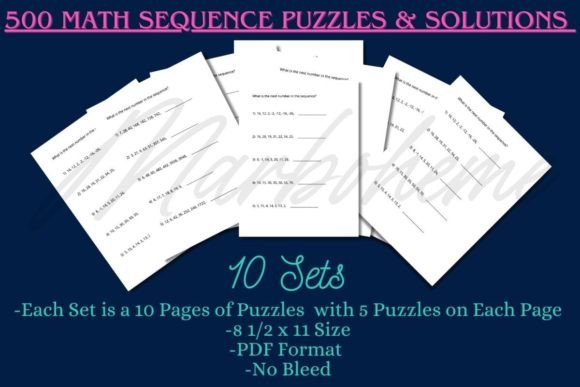
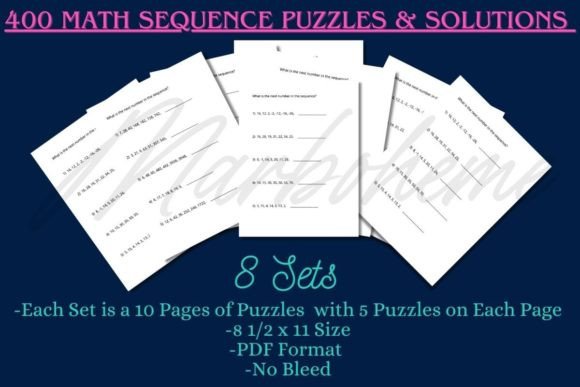
A recently introduced digital resource, 400 Sequence Puzzles for Adults Older Children – Digital Download, encapsulates all the strengths of sequence-based learning in a thoughtfully organized package. Rather than presenting an overwhelming bulk of problems, the collection divides its 400 puzzles into 8 distinct packets, each containing 50 puzzles with corresponding solutions. This structure supports incremental progress and prevents fatigue. The puzzles are formatted on 8.5×11 inch pages with no bleed, meaning they can be printed cleanly on standard home printers or integrated into larger documents without trimming issues. The digital nature allows for repeated use, selective printing, and even on-screen solving.
Structured Yet Flexible
Each packet functions as a self-contained unit. A teacher might assign one packet per week, while a self-directed learner might tackle a packet over a weekend. The solutions are included at the end of each packet, enabling immediate feedback—a crucial element for effective learning. Without solutions, puzzle books often leave users stranded, unable to verify whether an unrecognized pattern was truly valid. Here, the answer key empowers learners to self-correct and understand the underlying logic when they make mistakes.
Diverse Pattern Types
The puzzles are not limited to simple linear progressions. They weave in arithmetic sequences, geometric growth, alternating patterns, two-step operations, and even interleaved sequences where every other number follows a distinct rule. This variety ensures that the brain doesn't settle into a single heuristic but remains flexible, constantly adapting to new logical frameworks. For example, one puzzle might present a row like 3, 5, 9, 15, 23 ... challenging the solver to spot the increasing difference (+2, +4, +6, +8). Another might combine multiplication and subtraction, requiring a more layered analysis.
Versatility Across Formats
Because the files are easy-print and designed for both digital and physical use, they cater to modern consumption habits. Some users prefer the tactile feel of pencil on paper, printing the day's set and carrying it with them. Others might load the PDF onto a tablet and work through puzzles with a stylus. The no-bleed design avoids frustrating cut-offs, a common complaint with poorly formatted digital downloads. Additionally, the page layout is clean enough that screenshots or cropped selections can be used in digital teaching slides or online forums for group discussion.
How Learning Happens: Instruction and Discovery
Each puzzle sets up a simple premise: a row of numbers is given, and your challenge is to uncover the underlying pattern. There are no convoluted instructions or prerequisite formulas. This open-ended directive encourages exploration. Learners often start by calculating the differences between consecutive terms, then the differences of differences, or they examine ratios. When a pattern is spotted, the next step is to predict the following number (or fill in a missing element), cementing the extrapolation skill. The process mirrors the scientific method: observe, hypothesize, test, and iterate.
This straightforward approach lowers the barrier to entry. An older child can grasp the concept immediately, while an adult may be drawn into complex sequences that require multi-step reasoning. The included solutions do more than just provide answers; they sometimes reveal multiple valid interpretations, helping users understand that some sequences may have more than one rule—a valuable lesson in mathematical pluralism.
Real-World Relevance of Sequence Decoding
The abilities sharpened by these puzzles transcend recreational use. Consider the following domains where pattern recognition is critical:
- Programming and algorithm design: Writing efficient code often depends on recognizing repetitive or recursive structures.
- Financial analysis: Detecting trends in data series, stock movements, or economic cycles relies on sequence intuition.
- Music composition: Rhythmic and melodic patterns form the backbone of musical structure; many composers consciously play with numerical relationships.
- Cryptography: Classical ciphers and modern encryption are grounded in number theory and sequence complexity.
- Everyday problem-solving: From planning travel routes to estimating project timelines, the brain's pattern circuitry is always at work.
Engaging with deliberately crafted puzzles hones this inherent skill, making it more conscious and deliberate. It's no surprise that many competitive aptitude tests include sequence completion questions; they are a robust proxy for raw logical ability.
Using the Digital Download for Maximum Impact
The practical implementation is as important as the content itself. Here are some proven ways to integrate the 400 puzzles, depending on your role:
- For KDP publishers: The puzzles can be directly inserted into an activity book interior. Because the PDFs are derived from clean digital masters, inserting them retains clarity. Add a brief introduction, a tracking page for completed packets, and you have a fully functional book ready for market.
- For educators: Distribute one packet per week as a logic station during math centers. Solutions make it easy for students to self-grade, freeing up teacher time. Advanced students can be challenged to create their own sequences and write the rule—an excellent extension activity.
- For families: Print a set and leave them on the dinner table. It becomes a collaborative puzzle that family members of different ages can attempt together, sparking conversation and shared thinking.
- For remote workers and teams: Use them as a remote team-building exercise. Share a puzzle in a chat channel and see who arrives at the solution first, then discuss the reasoning process.
- For self-improvement: Keep a printed packet in your bag for commutes or downtime. Tracking your speed and accuracy over time offers a tangible record of cognitive stamina improvements.
The Role of Progressive Difficulty
A well-constructed puzzle set avoids an abrupt leap from trivial to baffling. The eight-packet structure allows for a natural difficulty curve, even if the exact ordering isn't labeled as "easy" to "hard." Users report that starting with any packet and working through sequentially builds momentum. The variation within each packet keeps engagement high, while the answer key ensures that when a genuinely tricky pattern stumps you, the solution becomes a learning opportunity rather than a dead end. Learning from solution explanations can be as valuable as solving independently, because it teaches new categories of rules—like modulo operations, prime-number skips, or two-tiered alternating patterns—that expand the solver's repertoire.
A Digital Format That Respects the User's Workflow
Unlike physical workbooks that commit you to permanent marks, a digital download means you can wipe the slate clean and retry puzzles months later. This resettability is especially beneficial for mastery-based learning. If you struggled with a particular sequence, you can revisit it fresh. The 8.5×11 with no bleed specification is a thoughtful touch often overlooked; it means that when you do choose to print, the margins remain intact, and the puzzles never creep into a binding gutter. For those who prefer digital annotation tools, the clean formatting allows easy import into note-taking apps like Notability or GoodNotes, where users can scribble their steps directly on the pages.
Cultivating a Pattern-Seeking Mindset
Consistent practice with sequence puzzles transforms the way you approach unfamiliar problems. Instead of feeling overwhelmed by complexity, you learn to break situations down into components and search for underlying regularities. This meta-skill—pattern seeking—transfers to reading scientific literature, debugging code, interpreting statistical charts, and even understanding social trends. The 400 puzzle collection, with its thoughtful segmentation and immediate answer validation, provides a low-stakes environment to cultivate that mindset. Each solved puzzle reinforces the belief that order can be found, and each error refines the method of searching.
Because the puzzles span a range of logical operations, they reinforce a flexibility that rote drills cannot. A student who has only practiced straightforward arithmetic might freeze when encountering a sequence where every third number is cubed. Exposure to diverse patterns dismantles the expectation of a single "trick" and builds tolerance for ambiguity—until the pattern clicks. That moment of clarity is deeply satisfying and creates a positive association with logical perseverance.
Beyond the Numbers: Educational and Professional Value
For teachers, the availability of 400 unique puzzles means enough content to last an entire academic year without repetition. Combined with the solution sets, it represents a complete supplementary curriculum for logical reasoning. For business owners who create educational products, the license usually permits insertion into derivative works, opening a pathway to create themed puzzle books, seasonal activity collections, or specialized cognitive training kits. The math sequences can be paired with other puzzle types—crosswords, word searches, mazes—to produce a rich, multi-modal brain fitness product. The versatility even extends to occupational therapists who might sequence these puzzles as part of graded cognitive rehabilitation, starting with simpler patterns and progressing to more demanding ones as clients improve.
Maintaining Engagement Over Time
The threat with any large puzzle set is monotony. The 400 Math Sequence Puzzles counter this with variation in structure and the motivational boost of the packet system. Completing 50 puzzles and checking off a packet feels like a milestone; it gamifies the experience organically without requiring an app. The solutions allow for self-competition—tracking the number correct on a first pass—which can be far more motivating than external rewards. Many puzzle enthusiasts find that their initial accuracy is around 70-80%, but within a few packets, it climbs above 90%. Documenting that improvement makes the intellectual growth visible.
Furthermore, the PDF format means you can share a single puzzle on social media, in a newsletter, or on a classroom screen without redistributing the entire file. This creates an entry point for larger audiences who might then seek the full collection. The clean presentation ensures that when shared, the puzzle looks professional and attracts curious minds.
The Underrated Skill of Reading a Sequence
In an age of complex data visualizations and algorithmic feeds, being able to read a sequence is akin to reading a sentence in the language of logic. It trains the mind to ask causal questions: What came before? What must come next? Is this a single rule or a composite? These questions echo in scientific reasoning, legal argumentation, and strategic planning. The 400 Math Sequence Puzzles serve as a concentrated training ground for this essential literacy. They are not just about numbers; they are about the relationships that bind them, the invisible architecture that turns a list into a meaningful progression. Whether you’re an educator seeking to ignite curiosity, an adult sharpening mental acuity, or a creator crafting the next popular activity book, understanding and mastering sequence puzzles opens doors to deeper analytical thinking and a more pattern-aware worldview.